Digital marketing for small businesses is the practice of using online channels like search engines, social media, email, and websites to attract customers without relying on expensive traditional advertising. Small businesses that invest in a structured digital marketing strategy see an average return of $5 for every $1 spent. This guide covers the core channels, how to prioritize them on a limited budget, and what actually moves the needle for businesses with fewer than 50 employees.
Why Most Small Businesses Struggle Online
Here is a number that should stop every small business owner mid scroll. According to recent industry data, 34% of small businesses plan to expand their digital marketing efforts this year. That means the other 66% are either standing still or pulling back. And in a market where 52% of small business owners say other small businesses are their biggest competition, standing still is the same as falling behind.
The problem is not a lack of effort. Most small business owners are already doing something online. They have a Facebook page. They post once a week. Maybe they paid someone to build a website three years ago. But effort without strategy is just noise. A Wix Vistaprint survey found that 76% of small business owners say their website is essential or important for growth, yet many of those same sites have no SEO structure, no conversion path, and no way to measure whether visitors are turning into customers.
Digital marketing for small businesses is not about doing everything. It is about doing the right things in the right order, with a plan that actually fits your budget and bandwidth.
What Digital Marketing Actually Means for a Small Business
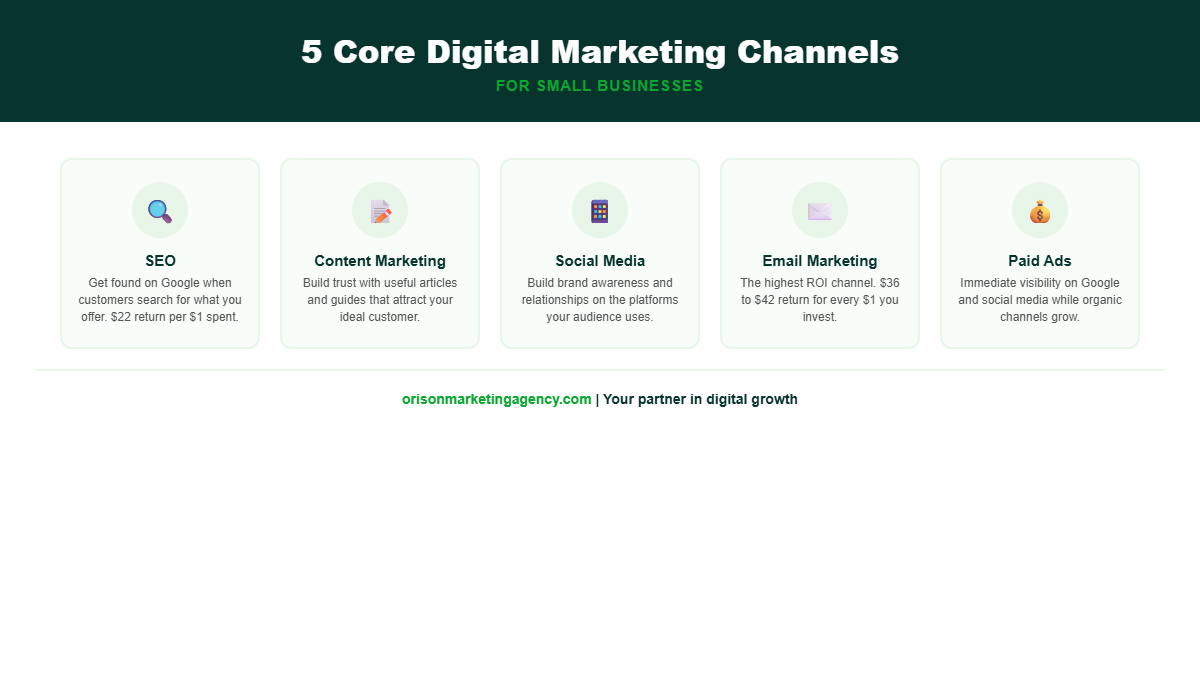
Digital marketing is an umbrella term that covers every way you show up online and attract customers. For a small business, the channels that matter most fall into five categories: search engine optimization (SEO), content marketing, social media marketing, email marketing, and paid advertising. Each one plays a different role depending on where your customer is in their buying journey.
Think of it this way. A potential customer who searches “best electrician near me” is ready to buy. That is an SEO opportunity. Someone scrolling Instagram and seeing a tip about home maintenance is not ready yet, but they are becoming aware of your brand. That is social media doing its job. A past customer who gets a seasonal reminder email about booking their next service is being retained. That is email marketing earning its keep.
The businesses that win online are the ones that understand this sequence and build each channel to support the others.
The Five Core Channels and When to Use Each One
Search Engine Optimization
SEO is the process of making your website appear in Google when people search for what you sell or do. For small businesses, this is often the highest return channel available. Industry research shows that organic search drives 53% of all website traffic, and SEO generates an average return of $22 for every $1 invested. That makes it the single most cost effective digital marketing channel.
Start with local SEO if you serve a specific area. Claim and optimize your Google Business Profile. Make sure your name, address, and phone number are consistent everywhere online. Then build pages on your website that target the specific services and locations you cover.
Content Marketing
Content marketing means creating useful information that attracts your ideal customer before they are ready to buy. Blog posts, guides, videos, and how to articles all fall under this umbrella. The goal is to position your business as the obvious expert so that when the customer is ready, you are already trusted.
Businesses that invest in content marketing see compounding returns over time. A blog post you write today can bring in traffic for years. The key is consistency. Publishing two quality posts per week, each targeting a specific keyword, builds topical authority faster than sporadic bursts of content followed by months of silence.
Social Media Marketing
Social media is where awareness happens. According to current data, 52% of small business owners focus on social media engagement for loyalty building. But here is the catch: only 38% of consumers say social media actually brings them back to a brand. That gap tells you something important. Social media works best as a relationship tool, not a direct sales channel.
Pick one or two platforms where your audience actually spends time. For B2B, that is LinkedIn. For local services, Facebook and Instagram. For products targeting younger buyers, Instagram and TikTok. Post consistently, engage with comments, and use social media to drive traffic to your website where the real conversion happens.
Email Marketing
Email marketing delivers the highest ROI of any digital channel, returning between $36 and $42 for every $1 spent. That is not a typo. The reason is simple: your email list is the only audience you truly own. Social media algorithms can change overnight. Google can update its rankings. But your email list is yours.
Start building your list from day one. Offer something valuable in exchange for an email address: a discount, a free guide, a checklist. Then send regular, useful emails that mix education with promotion. The businesses that do this well treat email as a conversation, not a megaphone.
Paid Advertising
Paid ads on Google and Meta (Facebook and Instagram) give you immediate visibility while your organic channels build momentum. The advantage of paid advertising is speed and precision. You can target people by location, interest, search behavior, and even past website visits.
For small businesses with limited budgets, start with Google Search ads targeting high intent keywords. Someone searching “plumber in Dallas” is ready to hire. A well structured campaign targeting those searches can deliver customers the same week. Social media ads work better for awareness and retargeting. Use them to stay in front of people who visited your website but did not convert.
How to Prioritize When Your Budget Is Limited
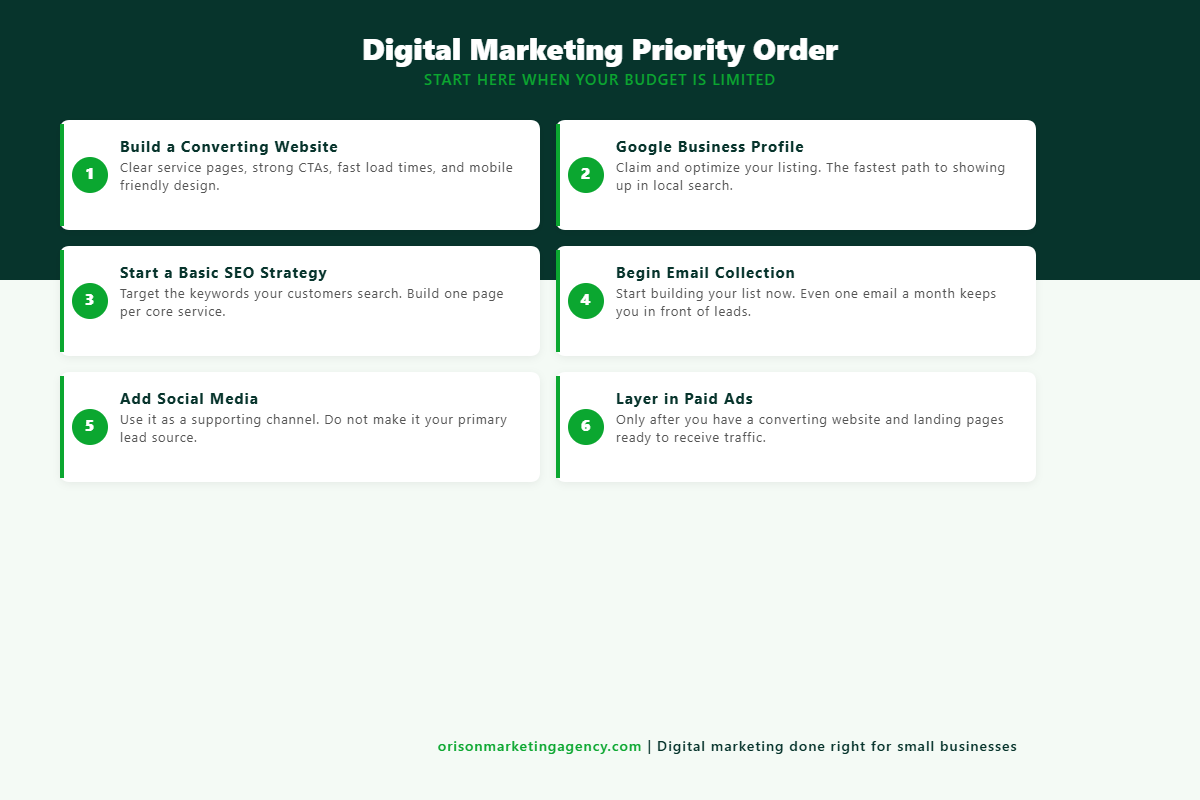
Not every business needs every channel on day one. If you are just getting started with digital marketing, here is the order that delivers the fastest results with the least waste:
First, build a website that actually converts. This means clear service pages, a strong call to action, fast load times, and mobile friendly design. 81% of consumers say it is important for businesses to have a branded website, and 15% consider the lack of one a dealbreaker.
Second, claim and optimize your Google Business Profile. For local businesses, this is the fastest path to showing up in search results.
Third, start a basic SEO strategy. Target the keywords your customers actually search for. Build one page for each core service you offer. This is where long term, sustainable traffic comes from.
Fourth, begin email collection. Even if you only send one email a month, start building the list now.
Fifth, add social media as a supporting channel. Do not make it your primary lead source unless your business is inherently visual (restaurants, retail, fitness).
Sixth, layer in paid ads once you have a converting website and landing pages to send traffic to. Running ads to a website that does not convert is the fastest way to waste money.
Want help building a strategy that fits your budget? Book a free discovery call with Orison Marketing Agency.
What Separates Businesses That Grow Online from Those That Do Not
After working with small businesses across the United States, the pattern is clear. The businesses that grow online share three traits. They have a documented strategy, even if it is simple. They measure what matters (traffic, leads, conversions) instead of vanity metrics (likes and followers). And they stay consistent for at least six months before judging whether something is working.
The businesses that stall tend to jump between tactics, chase trends, and expect overnight results from channels that reward patience. SEO takes three to six months to show momentum. Content marketing compounds over a year. Email lists grow slowly before they become powerful. There are no shortcuts, but there is a clear path.
55% of small business owners are already using AI tools to improve their marketing efficiency. The playing field is shifting. Businesses that combine smart strategy with the right tools will outperform competitors spending twice their budget but without a plan.
Frequently Asked Questions
What is digital marketing for small businesses?
Digital marketing for small businesses is defined as the use of online channels including SEO, social media, email, content, and paid advertising to attract, engage, and convert customers. It is designed to deliver measurable results on budgets smaller than what large corporations spend.
How much should a small business spend on digital marketing?
Most industry benchmarks recommend allocating 7% to 10% of gross revenue to marketing, with at least half of that going to digital channels. For a business generating $500,000 in annual revenue, that translates to $35,000 to $50,000 per year across all digital efforts.
Which digital marketing channel has the best ROI?
Email marketing delivers the highest average ROI at $36 to $42 per dollar spent. SEO follows closely with $22 per dollar invested. Both are long term channels that compound over time, making them ideal for small businesses focused on sustainable growth.
How long does it take to see results from digital marketing?
Paid advertising can deliver results within days. SEO typically takes three to six months to show measurable traffic increases. Content marketing and email list building compound over six to twelve months. The most effective strategies layer quick wins (paid ads) over long term growth channels (SEO and content).
Do I need a website for digital marketing?
Yes. Your website is the foundation of every digital marketing channel. SEO drives traffic to it. Social media links back to it. Email campaigns convert through it. Without a website that loads fast, looks professional, and has clear calls to action, every other channel underperforms.
Need help putting this into action? Orison Marketing Agency works with small businesses across the USA. Book a free discovery call.